Showing posts with label artwork. Show all posts

Sunday, July 24, 2011

Receptions and Things


So, I was feeling pretty good about being the featured artist at this charming new cafe, Amicis. There's not all that much wall space and I have plenty of prints and framed prints and empty frames, and I have a week to decide what will go. I was feeling pretty good about it until I made this postcard this morning an sent out invites to a ton of people and started getting back responses.

Seeing the invitation on the internet has started one of those spiraling-out-of-control feelings that I need new prints. My head is filling up with thoughts of a couple new monotypes and reprinting a few blocks in different colors. I need to stop thinking and be happy with what I have, but as much as I try and talk myself out of it, I know I won't be sleeping much this week.

Thursday, November 4, 2010

Published!

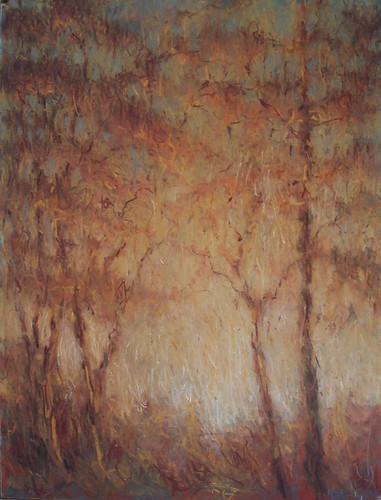
So, there was this crazy week at the beginning of September where I had about seven art deadlines I decided I would attempt within a week. After it was over and I caught up on sleep, I wondered what the point was, and if it was worth it to enter juried shows and write proposals for shows and try to get grants. I'm still not sure, but I'm happy to say that my efforts thus far have been rewarded. My prints made it into the shows and I sold a couple of them, as well as the pastel on the left, whose framing in an early 19th century mirror and the weekend I spent doing it is worthy of its own post.

The big news, though, is that this pastel won an award in this year's Pastel 100 and will be in the March/April issue of the Pastel Journal. Exciting stuff, although I can't help wish that it was still mine.

Thursday, August 12, 2010

Waterless Litho Luv, AKA, Somebody Hide the Calligraphy Pens Please

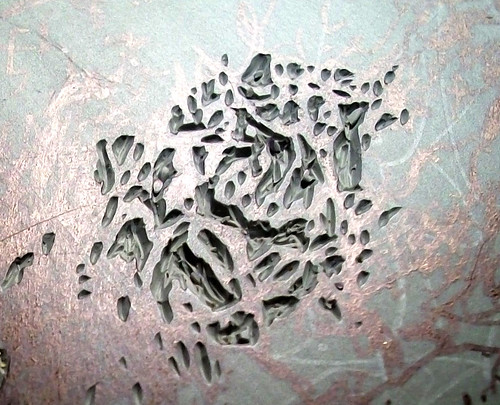
So, a few months ago I had about an hour to pop into a workshop at the Dayton Printmakers Co-Op by Sinclair printmaking professor Kevin Harris for a quick lesson on waterless lithography. For those unfamiliar with the process, it goes something like this... you draw on a grained aluminum litho plate, cover the drawing with a thin layer of silicone, wash off the drawing and voila, you are left with a plate which repels rubber based ink anywhere there is silicone. You can also use the process by transferring a Xerox copy to the plate with lacquer thinner or acetate and then going through the same steps. Sounds pretty simple, eh?

It's not that complicated of a process, but of course there are some variables and things that can go wrong and things you can spend a lot of time correcting. Otherwise it would be something different than printmaking. You are supposed to be able to draw with any water based media so I tried about everything I had around the house, from watercolor pencils to some mixture of Akua Kolor ink and modifiers of who knows what kind, to sharpies and gel pens, which are also supposed to work. I spent a lot of time drawing. Note to self: Always do a small test before investing a lot of time drawing! Needless to say, I wasted a few plates and drawings and hours, but I did get to enjoy the drawing part of it. And I got smart and started scanning in my drawings so in case I ruin the one on the plate I can still try the Xerox method, even though I'm resistant to using anything that is a "reproduction." I think I'm afraid that once I go down that road I'll start going through the thousands of photographs that live on this machine and start trying to print those instead of coming up with new things.

Anyway, I discovered that there's something about the way ink flows onto these aluminum plates from a calligraphy pen, those kind you dip into the ink, that's a little bit magical. There's something about the smoothness of it and the way it clings to the surface that's graceful and sexy and it's hard to resist. And it's perfect for drawing tree limbs. There's also a randomness to the prints that I really like. I keep ending up losing some of the fine detail in the silicone process, as this is one of the variables that it's difficult to get just right. You get it on a little to thick or too thin and then you can't wash away the drawing or you wash off too much. But in a way I like that. It gives a neat and tidy drawing a little edginess, or something like that, and the random stuff can happen with in the inking is also pretty appealing to me.

And I get to play with ink. I've been inking them up with a rubber based black VanSon ink and then applying Akua Kolor over the plate. It's a trial and error process, as it's difficult to get the Akua Kolor just the right consistency to adhere to the silicone...it naturally wants to bead up. Thin layers brushed on and feathered out very gently seem to work best. I can't get any of the softness I like about my woodcuts with the process, and believe me I've tried and failed, but there's something stark and graphic about the end product that I like. And wow, do I enjoy the drawing part.

Tuesday, August 10, 2010

Art On The Commons, The Morning After

So, Sunday I experienced my first art fair, Art On the Commons in Kettering, Ohio. It's a pretty big deal around here with about 100 artists juried in, 35 of them local, including me. I'm still thinking about it and trying to figure out what I did wrong and what I did right, and if it was worth the time and effort. Today I'm thinking it was definitely worth it now that I've cleaned up the aftermath of my whirlwind preparations pictured above.

One of my biggest mistakes is evident in that photo...the unfinished and experimental prints. A couple of weeks before something like this is not the time to be trying new things and making new prints, but I just couldn't help myself. When I should have been packaging up prints or reprinting things that I know sell well I was trying out some crazy hand inked collagraphs made from plants, carving and printing a big, yet-to-be-completed reduction print and trying to crank out some monotypes using pieces of lino blocks from previous prints. And there were the three reduction prints that still needed the last impression on over half the prints. I was a printmaking machine and I couldn't stop. I guess, in retrospect, that I didn't want to stop. After all, printing is great and I had a good excuse to be doing it. But the result of my actions was not so fun... two solid days and nights of cutting foamcore and mats and framing, printing up business cards and other collateral at the last minute and almost slicing my finger to the point of needing stitches, and packing my car up like a madman while trying not to bleed on any artwork.

I guess I'm a little regretful that I didn't make the most of the time I had to prepare, which left me a little loopy and not at my sharpest the day of the event, but on the other hand I got to spend the better part of my free time the past few weeks making prints. Or at least trying to. What could be better than that?

One of the craziest things I did during the preparations, though, had to be getting out oil paints and spending half a day painting over a canvas I started 10 years ago, especially considering the fact that I never paint. That is almost tied with the twenty or so hours I spent drawing on two litho plates when I don't know how to do lithography, just because once I started drawing with those litho crayons I really liked it and couldn't stop. I did get one good print from one of them before I ruined the plate, but I guess I can't consider it a good print because it's on newsprint. It was a damn fine litho crayon drawing, though.

Either I have ADD or given an excuse to make some art, that's all I'm going to be doing with every second of time I can find. Anyway, back to the point of the post, the art fair. It went well. I didn't make a huge profit but I slightly doubled the money I had into it, so I can't complain even though I had higher expectations. My expectations were so high, in fact, that I won't have to package up or mat or frame anything for a while, and I can focus on just making art. I've got the business part out of the way through the holidays and I won't have to spend any time or money getting ready for ARTtoBUY at DVAC this year, and I probably have enough packaged prints to start trying to spread them around the Miami Valley...and beyond.

The highlight of the whole thing, though, had to be the people. I just wish I hadn't been so tired and had been more engaging, and I wish I would have remembered to bargain with people who came back for a second look. But it was great to see people I hadn't seen for a while who came to see me because they saw my name in the paper. Also great were the moments when people recognized my work from DVAC and the Cannery, and even better were the three times when absolute strangers came up to me and told me they read this blog and talked about specific posts. How cool is that?

Looking back and writing about it and thinking about it, I would definitely do it all again, in a heartbeat. There's no way I would trade in a few days of crazy-busy for the joy of spending July 2010 making prints and trying new things and meeting people interested in how I print and meeting people who recognize my artwork. I guess after all the years I've spent having my hard work attributed to "artist rendering" that I have to say tonight that it's feeling pretty good to be the artist Andrea Starkey.

Wednesday, February 24, 2010

20th Annual Dayton Area Works On Paper


So, it was about a year ago when I entered my first juried show, the 19th Annual Dayton Area Works On Paper. To date, my percentages are pretty good, as this year it was the 4th juried show I've submitted to and the 4th show for which I've had an entry accepted. Even better, when the show opens this Sunday I'll be receiving my first award.

When I was trying to decide which three things to enter I thought I should enter similar pieces to show a "body of work" but then I ran into trouble when I really wanted to enter a couple of the new collagraph prints I've been making out of trash. They are interesting and colorful and different from what I've been doing and I like the way they look, but the prints I've pulled thus far have a few little printmaking mistakes were more than this perfectionist could bear. In the end I submitted three unrelated pieces in different mediums, and as soon as I dropped them off I began to question the wisdom of that decision.

But actually they were related pieces of artwork. They were personal. They all meant something to me. The reduction print of the morning view I love whenever I turn right off my street. The monotype of Alex and Anna when they were younger I did this year on my first Christmas Eve spent without my children. The soft pastel portrait of my grandfather I gave him on his final birthday.

I had two of the three selected, and the monotype almost made it in as well. I'm not sure what it means, but I think it means I should keep entering juried shows. And I think it means that making art that you have a connection to might be more important than making pretty pictures. Representing the the things in life that stir your soul and move you and make you smile and make a tear run down your cheek...

And maybe that's what it takes to be an award winning artist.

Saturday, February 13, 2010

Road Into Town, Continued Once Again


So, I put the final layer of ink down on my Road Into Town print a couple of Sunday nights ago, giving it just enough time to dry before throwing it into a frame to submit to Dayton Area Works on Paper the following Monday. I've blogged about the making of this one here, here, here, here and here, but I just wasn't able to bring myself to print the final reduction until faced with a deadline. And I wasn't thrilled with the end result, although it did look good matted and framed.

Apparently good enough to get into the show. The Road Into Town is completed at last, or at least version Number 1.

Tuesday, January 5, 2010

New Year, New Print & Out of the Mouth of Babes Comes Wisdom?

So there it was, January 2 of the New Year, and I had just finished a reduction print and was thinking about clearing up my printmaking mess and putting away the Christmas decorations. Instead I kept staring at the two 12" x 12" linoleum blocks my 14 year-old son had picked out for me as a Christmas present, and he was putting the pressure on.

"Those are big, you need to make something cool!" and "What are you going to print from those?" were just a few of the comments I was getting on a daily basis. He was so proud of himself for picking out a gift he knew I would enjoy that he was beside himself with anticipation of what would come from it.

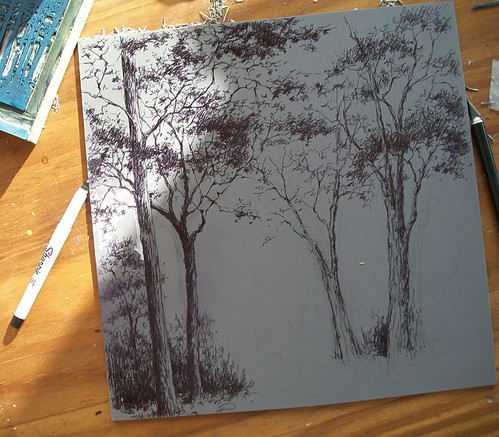
I've been thinking for a while that I wanted to a reduction print based on this pastel I did earlier this year, with a greenish sky and orange trees, and I decided now was the time. I proceeded to draw out something similar in Sharpie on one of my new Christmas blocks. While I was drawing and looking at the pastel it made me think about what direction I wanted to go. For some reason, I am compelled by the idea of having prints look more like drawings, of having more freedom and expressiveness line. I don't want them to look graphic or like a copy of a photograph, I want them to look in some way representational of what I see, and have some feeling and movement to them, and maybe impressionistic is the word to describe it.

And then I start to think, why am I not just making pastels? This one is pretty decent and it's a hell of a lot easier than printmaking. But, as anyone who prints will understand, there is nothing quite as rewarding as pulling that paper off the block and seeing what you have created even though it does take a lot of planning. Is it possible to make something planned look expressive? Or even more important, is it possible to create and carve something expressively that has to have planning to it? The planning kind of takes some of the freedom out of it for me. So that, I think, is one of my goals this year, to find a combination of spontaneity and planning that is evident in the finished print.

So, as I began to draw out the future print on my fresh piece of linoleum, I had a lot of things running through my head. I was thinking about how it would work out, and how I would carve it and how I would refine the lines before I carved. Then my son came into the room. He said something like "Too bad you can't make a print look like the way you draw." Hmmm.

I've never tried to print the way I draw and sketch. I was getting kind of close to it with that sycamore reduction print I just finished, but that was planned. I've always drawn, and then refined my lines to what I think a print should look like before I started carving. Maybe the key to finding the balance between what is planned and what is spontaneous for me lies somewhere in following the lines that come naturally to me when I draw.

I have no idea how this will go as I follow these Sharpie lines, but it's worth a try. Game on, son. I'll take that as a challenge.

Saturday, December 5, 2009

Road Into Town, Continued

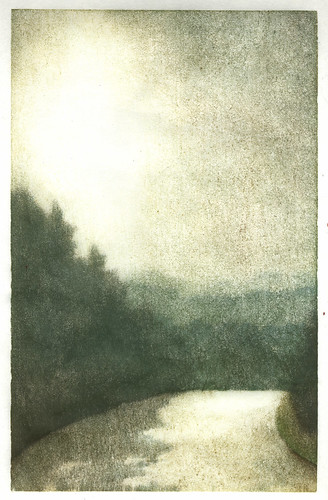
So, I put this monotype in DVAC's ARTtoBUY gallery shop. It was kind of a last minute decision because I wasn't sure I wanted to part with it, but since I'm doing the reduction of the same scene I thought I could let go. It's the view when I turn right after pulling out of my street, and it's quite a lovely view headed down the hill that leads into Bellbrook. It always looks different depending on the time of day and the day of the year and the atmosphere. In reality it doesn't actually look all that much like this, but this is what it feels like to me. I guess that's the reason I thought about keeping it. It has personal significance.

Last night was First Friday and I was at The Cannery after leaving DVAC, and I was approached by a group of women who had come from there as well. One of them had just purchased three of my prints, including this one. We talked for a while and she told me about trying to decide which of my prints to buy and of her plans to hang them together. It turns out that she also lives in Bellbrook, and not only does she live in Bellbrook, but she lives almost directly across this road from me.

I love it that without knowing it, she bought a representation of something she sees every day. And that my "Road Into Town" monotype is her road into town.

Saturday, November 7, 2009

The First Demonstration

So, last night I did my first printmaking demonstration at DVAC's opening of ARTtoBUY. First of all, the gallery looked great and I can't believe the transformation of half of it into an art gift shop. Hats off to Patrick Mauk who runs the thing, as he did an incredible job. Secondly, that place was filled! It was three hours of non-stop people and at many times it was difficult to even move about. I can see why they call the event "highly anticipated" on the website. I'm looking forward to my first volunteer day so I can look around and see what items other area artists have to offer. There were some gorgeous looking ceramics pieces and and lots of handmade jewelry.

The reason I didn't get a chance to look around was that I was incredibly busy the entire time I was there. I talked for three straight hours without a break while printing and showing prints I'd done and explaining the process. I think I actually did much more explaining than demonstrating, which was OK, because printing while talking isn't exactly something I'm very good at. I also learned a few lessons about demonstrating, so I think the next time will be easier and I'll be more prepared.

There were a few things I did wrong. First, I was running late, which isn't a big surprise. That left me setting up as people were arriving, and I have to admit I was a little disoriented. I'm so used to my printing set-up at home that it wasn't easy to replicate it in another environment quickly. I hadn't realized that I had become such a creature of habit when it comes time to print. I always know which brush is for the blue and where it will be, so looking for it threw me off a little. Actually the brush/ink thing was a problem that I'll have to give some thought to before I attempt this again. So was sitting down. I've been printing at my kitchen island standing up and for some reason sitting just felt uncomfortable, and my back agrees.

I'm glad I had thought to bring all the sample prints from my demonstration block (above) because I strew them about the table and it looked as if I had just done them, and I could talk about them as I was inking up the block. That block I had made, with several different print combinations, was definitely a good idea. It was easy to explain registration, which a lot of people were curious about, as well as layering colors and having different blocks for each color.

Also, I'm glad I thought to bring what was left of the block from a recent reduction print along with a couple of proofs. It made the proccess easy to explain. In hindsight, though, when someone wanted to purchase one of the proofs which was a different color than the others in the edition, I probably should have let her. She really liked the color. The problem was that I really liked the color to, and I wanted to keep it for myself. I've got to get over that if I'm ever going to make money at this.

I'm a little on the fence as to whether or not it was a good idea to have prints for sale on the table with me. It was probably a good idea, but it kept me from demonstrating because I spent so much time explaining how each was done. Maybe there's a line there that I have to figure out - am I there to show what I do or am I there to talk about it?

And finally, about the talking... It seems like there were mainly two groups of people I talked to. There were people who were not artists or those that used a totally different medium who liked my work and might potentially buy something, and there were those who did similar types of artwork or printmaking who were intensely curious about what I was doing. I enjoyed both groups. There are definitely some people out there who would like to give this a try and I think I could be a rep for Akua Kolor Inks. People who print and have never tried water based inks are amazed by their properties and how they can be used like paint. I have to admit that I had a little difficulty when there were times I had to balance the two groups at once, because I would definitely prefer to talk about ink and paper and barens over trying to sell something.

It was a positive experience. I enjoyed it and the next time I will be more prepared and less apprehensive. As I was on my way home, I started thinking about the demonstration. I was thinking that maybe I'm better suited to showing people how to do this rather than trying to sell what I've done.

Sunday, October 25, 2009

Things That Rank As Cool

So, it was a year ago, First Friday of November 2008, that I went to my very first First Friday. I had known about this First Friday thing since it's inception, where the galleries downtown are open late (and serve drinks), and had thought that it was something I'd like to attend but never really had the opportunity. That night, I just happened to be having beers with a friend from work and I suggested the gallery thing and we did it. And actually, life hasn't been the same since then.

I remember thinking and saying that I wanted to be one of the artists who's work was on display. I thought, for the first time, that I could do this thing. I could be an Artist. And I wanted to do it, and I shot for that goal.

Exactly one year later, I will be.

Dayton Visual Arts Center has this ArtToBuy event, where they turn part of the gallery into a shop during the holiday season. I'm one of the artists and I'll be selling prints. And...I'll be demonstrating that night, demonstrating hand pulled prints Moku Hanga style.

Wow. What a year. And I owe a big thanks to those whose encouragement and support helped me get here.

Getting There

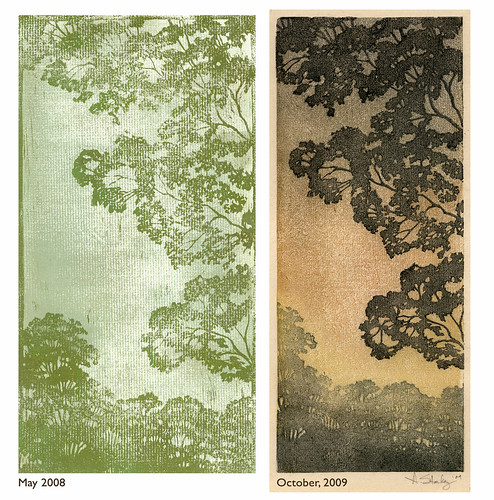
This is the first tree I carved. It was on EasyCut around the end of May in 2008. I remember being really disappointed when I tried to print it. The paper was all wrong. I think I printed on dry pastel paper. And I couldn't get good coverage. I was using Speedball Water Soluble ink applied with a brayer.

I reprinted it this week with Akua Kolor waterbased inks, brushed on, doing multiple impressions on the background and lino block, and printed onto the Japanese handmade paper Kitakata.

What a difference materials make! And a little more experience. I just wish, now that I've started printing from wood, that this was not carved out of that squishy stuff. It is pretty near impossible to get consistent registration with this stuff. It is just too soft. Sure, it is easy to carve, but there's just something about that baren on wood that feels better, and right.

Tuesday, October 6, 2009

Making Some Progress Part II

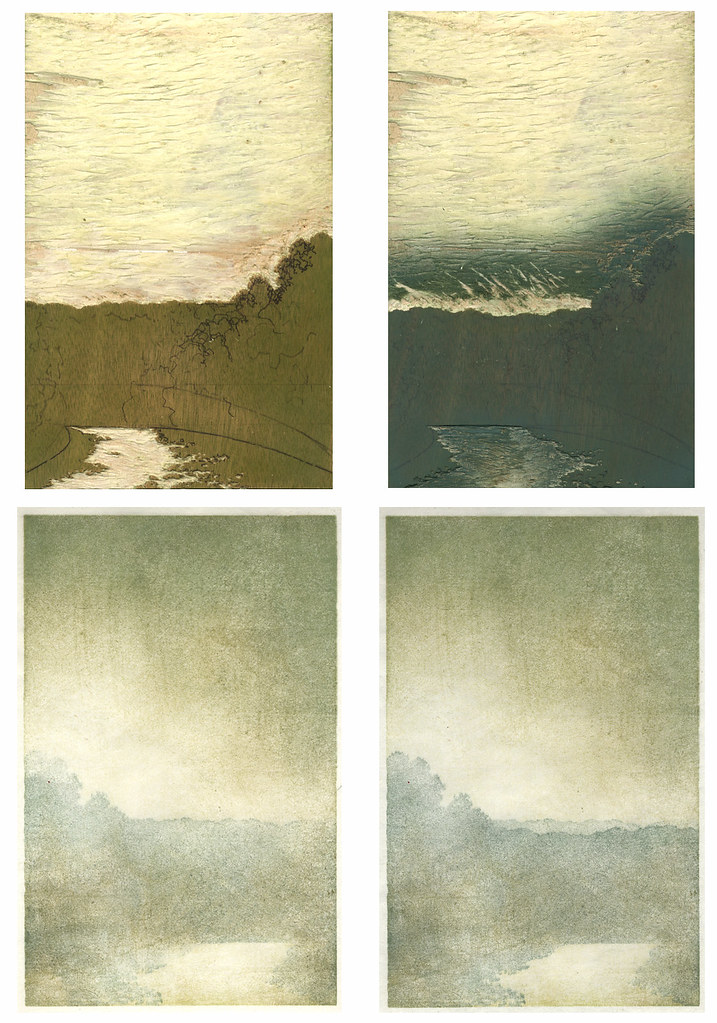
I was originally going to include these with my previous post, but once I got off the subject with color, I thought it might be better to start fresh. Here is my block after the first and second reduction, as well as the printed results. The print from the first reduction is a little different than the block. I ended up carving away more of the shadow in the road because the shape was looking a little awkward to me.

Now that I see them all printed, I can tell that I've made the some of the same mistakes I've made before. There's not going to be enough variation in the road to make the lightest area pop. I keep going too light with the first and sometimes second layer, over and over again. I'll see how it goes, but I'm kind of thinking I may need to carve another piece to add some color in that area later. I also need to watch my edges. There's a spot in the print I'm scanning right in the middle at the bottom where I've bumped into the edge of the shadow area, and there are a few similar spots on some of the others. I'm hoping that if I am very careful I can even those out in the next impression.

Overall, I'd say things are progressing nicely. I did lose one of my favorites when my baren slipped off the top of the trees, resulting in a couple of little specks right in the middle. I should just stop printing it now, instead of using it as a proof, because each time I see that it is going to remind me not to make that careless mistake again. On the other hand, the more I'm reminded, maybe the less likely I'll be to let it happen again.

Someone told me I'm too critical of myself when I write about artwork I've done. But then again, someone else once told me that when you stop being critical of yourself, you stop trying to do better.

Tuesday, September 29, 2009

Reprinting

So, I am in the process of reprinting some things, for a few different reasons.

I've committed to taking part in Dayton Visual Arts Center's holiday ARTtoBUY event, where they turn part of the gallery into a shop filled with member's artwork for two months. I had to fill out an inventory sheet listing my prints and how many of each print I had available, and I think it is probably a good idea to have that many of each one available.

With the reduction prints, that's an easy number, because once you are done, there are no more prints to be made. The only decision to be made is how many I want to hold back. For many of my early linocuts, however, I only printed one or two that were successful, and several of those were done with oil paint and I don't trust their longevity. Since I switched to the Akua Kolor inks, I've been meaning to redo them when I could find the time.

Also, now since I have an Etsy shop and have had my first few sales, suddenly having a little bit of an inventory seems like a good idea.

The problem I'm having, however, is that I'm finding out that I don't really like to reprint things that I've already printed all that much. It feels a little bit like work, instead of fun. And I keep blowing prints. Since I print multiple, brushed on impressions, I know I am going to lose a couple here and there to bad registration, but I am losing them for careless reasons, like the baren slipping down into carved out areas or off the side. It gets a little frustrating when you are down to the last impression.

I don't know, maybe I'm just not in the right frame of mind. After printing off wood, suddenly linoleum doesn't hold my attention like it once did. It doesn't feel the same. The ink slides off compared to the pressure you exert on wood, and how you can vary that pressure for different effects. And I've noticed that when compared to wood, linoleum has this strange magnetic power to attract every piece of dust or dog hair floating around. Not good during shedding season.

Or maybe it is just that I have too many ideas for new prints, and rehashing the past doesn't seem to be holding my attention or my interest.

Thursday, September 10, 2009

Evolution of a Tree Print

So, this is a story of printmaking gone wrong, or just not tuning out as planned. I always have such high expectations when beginning a print. Thoughts of "Oh, this is the One, this One will be good and I'll be happy" fill my head after the first few impressions until I encounter some kind of obstacle during the process and end up with something different than what I had planned.

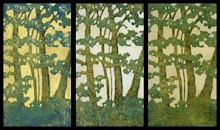
The first three images were carved on a leftover piece of pine stair tread I found in my garage. It was my second attempt at carving wood as opposed to linoleum, and I quickly discovered that I preferred printing off the wood. I was very happy with second impression (first image), but impatience got the best of me and I proceeded to carve into the slab of wood when it was still damp. I learned a new lesson. If carving grainy wood, let it dry out before going at it with your carving tools. I lost some huge chunks (by huge I just mean larger than the thin branches) along the grain, perfectly vertical. Suddenly, my efforts turned to making these errors less evident as opposed to focusing on the finished print. I abandoned my original plans and proceeded to create something that is so far removed from what I had envisioned that I even have trouble describing it. It is growing on me, though, as I look at all of them taped to my kitchen wall drying.

Before I made the final reduction (the black in the second image) I decided that now was the time to make the print in my head that used two separate blocks for the sky and tree. I then printed about 24 of the third image, and I knew this print was going to be good. I was sure of it. I made a print on some architectural vellum I had around the house and mounted it to a piece of birch faced plywood leftover from panels I had made a few years ago for my fridge.

I spent three or four days carefully carving it out, growing increasingly anxious to try out the newly carved leaves and branches on my sienna colored background. I knew there was a problem as soon as I started to make the first impression. Apparently the paper had stretched when I glued it to the wood panel and the image I had carefully carved was about 3/4" wider than it should have been. I would write my initial reaction, but I'm fairly sure my mom would give me a hard time about the expletives. Now I have a stack of prints of the third image that I haven't been able to come up with a way to finish. All I have left of the original block is the black shadow area in the second image above, which just looks wrong and out of proportion on this version. I may revisit it at some future point, once I'm sure that I have paper that won't stretch (suggestions?).

This brings me to the final image, which is where I'm at now, after carving out a rectangle to put some color in the background of my newly carved tree. This is going to be the One.

Tuesday, September 8, 2009

Etsy

So, I've finally started an Etsy shop. I've been putting it off for one reason or another for quite a while. Thoughts like "I need to make a chop first" and "I need to make more prints first" and "There is something wrong with every one of these" have continuously been a stumbling block.

Necessity is indeed the mother of invention. I need to invent a way to support my printmaking habit.

Monday, September 7, 2009

2009 DVAC Member Show

This monotype print was recently in the 2009 Dayton Visual Arts Center Member Show. The theme of the show was "Green" and I decided to not take it too literally. That's after I had two other prints matted in the frame that are actually green. There was something about this one that I just really liked, so I went with it.

I liked it until the unimpressed friend I went with said something to the effect of, "You could have done something better." I was already second guessing my decision to submit this bamboo print after my mother had commented, "I thought you were going to use that Mist print."

Oh well. At least someone at DVAC must have thought it was decent. It was on the stand alone wall right when you walk into the gallery with two other pieces of artwork. I probably made a good decision afterall.

Wednesday, May 20, 2009

Juried Show Number Two

So, I just received notification that this 8" x 10" soft pastel on panel was selected for "The View 2009 - A Juried Landscape Competition" which is open to all Ohio artists. 271 pieces submitted, 58 selected.

This thing has been everywhere in my house over the past couple of years. It's been stacked in a pile of pastels on the top shelf of the closet in my laundry room, leaned up against the wall behind a dresser, placed on several different bookcases, and right now it is on my kitchen window sill. I'm not all that sure that I even like to look at it anymore. And now I have to look at it a lot and figure out just what kind of frame it should go in.

I was a little surprised that of the three I submitted, this was selected, because I thought it was the weakest. Guess that shows what I know! Now I am two for two with the juried art shows, though, and I like that.

Monday, March 30, 2009

Last Year's Grasses, Finished

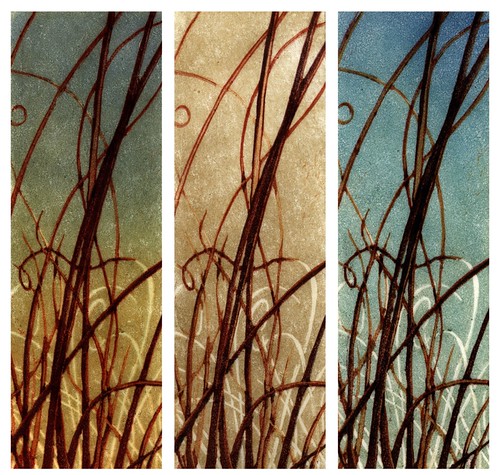
So, here's the finished print from my last post. I'm feeling so-so about it. I discovered and worked out some things with color and value which will help me out in the future, and then proceeded to totally overuse them. I also had some vision problems about half way through this one and once I missed a bunch of stray orange marks outside the edges and inside some of the prints, I kind of lost interest and just wanted to get it over with so I could move on with my life.

This is #5, my fifth reduction print. The first one was back in August, and I ended up disappointed with it after the amount of time I had put in. I tried again at the end of January and that print ended up in a juried show, giving me some encouragement to keep going with it, even though I was disappointed with it as well. I'm starting to wonder when I'm going to look at a finished print and say "I am happy with this." But yet I am totally compelled to keep going with it.

I am satisfied with the color on these. There are about twelve-fourteen of them, each on a different background. Using different backgrounds helped me come to the realization that I think I prefer that things have either a background of yellow ochre or one of the umbers. And I realized that's where it gets a little tricky, or easier, because once you have a background every color choice you make is dependent on what's below. You have to put some thought into it if you want to end up with mud, but you can acieve some great intensity if you do it right. I had been trying to make colors darker by making them darker until I had a totally "DUH" moment. This is transparent oil paint in thin layers. If I want to make red darker, don't add black to the red, print a thin layer of viridian. Rich darkness achieved, finally!

I also discovered that a very integral part of this whole printing process is being able to see what you are doing. Into my second impression of orange on the grass, after moving lights around and adding lights, I suddenly realized that the problems I was having with lighting were not due to the lighting. I couldn't see very well! A cheap pair of reading glasses confirmed it. My prescription had changed and I didn't have a clue that it had happened. Carving was much easier that night, but I didn't bother to put them on when I was printing and looking at my prints.

Big mistake. I missed stray printing marks all over the place, stray printing marks that I didn't even notice until a day later, when I took out my contacts and put on my glasses because my eyes were still bothering me when I worked on the computer. The thought had briefly crossed my mind that the problem could be the contacts, and not my eyes, but I had dismissed it. Once I took them out and put on my glasses I immediately remembered a comment that my 13-year-old son had made a few days earlier, about feeling dizzy. Even though our cases are completely different and his is marked, he had somehow switched them. I'm still seeing the eye doctor this week, because the reading glasses did make a difference, and I am also keeping my contacts in a different bathroom from here on out.

Now the question is what to do with all of these prints, that look ok for the most part, but have these little errors all over the place, especially outside the edges. Maybe I'm just too picky, and once I finally open an Etsy store people won't care about the little mistakes. Or maybe I'll just sell them all as proofs, or mat them to hide the edges, or, leave them stacked in that growing pile of artwork.

This whole thing is such a learning process, and with each print I've worked out problems I had in the previous one. And I'm totally in love with the process. But sooner or later I'm going to have to try and generate a little income from it, so it can start paying for itself.

Sunday, March 22, 2009

Last Night's Prints, This Morning


So, I've noticed that there are quite a few printmakers who post pictures of their prints laid out drying. I get it now. It's kind of satisfying to see them all lined up, after the care and attention that's been given to each one. These have been reduced twice and have had around 6-10 impressions apiece, and this is just the background.

I've also noticed that with most of the other reduction prints I've seen spread out like this, the prints are all the same. I think picking out a color combination and sticking with it for the whole edition is supposed to be part of the whole goal of this printmaking process. I don't know, but I don't think that's for me. I like random. I think when I look at mine, I like them all to be different, each special and unique in its own way.

The next step in this one will be a lot of carving, before I get back to printing again. And, if this next printing phase goes like my previous tries, I'll lose about five of these twelve little colorful gems to careless errors or poor color choices. But at least now I'll have this image to remember them by, and the promise they all once held.

Thursday, March 19, 2009

Printing With Oil Paints 1.0

So, since I first began hand pulling prints about a year ago, I knew right away that I liked carving the blocks. I also knew I had a lot to figure out about ink and paper, because I wasn't having much luck on that front. I tried dry paper, damp paper, wet paper, thin paper, thick paper, cheap paper, expensive paper, all without producing anything close to a satisfying result. And the same goes for the ink... Speedball water soluable ink out of the tube, and in various stages of thinned out using a variety of methods to get it on the block. Next I moved on to watercolors. I liked them better from the start, but I was still having problems with the pulling prints process.

Now I'm not saying that I haven't made some prints that I like, because I have. But there's always something kind of disappointing about them. The reduction prints seem to start off well, but by the end it seems like a struggle to find the enthusiasm to finish them because there's something I've done that I wish I hadn't. The paper was too wet for one impression and crinkled. The color was wrong on one impression and threw off the whole image. The registration was off. There was a big line outside the printed area where I missed wiping off excess color and didn't notice while printing. The list could go on and on.

But yet I've been compelled to go on. Half way through a print I'm already thinking about what's next and what I'll do differently to make it better. It's like an addiction, and I can't get enough of it, even though the printing process itself had become frustrating.

Then I tried using oil paints. My first attempt is to the left. I could get nice, intense, vibrant colors that were transparent, with texture. I could brush on the paint and thin it out and work with the paint on the block. And I could use dry paper!

My first reduction print with with the oils is below. The printing process that has been taking a week or more to end up with maybe a couple of decent prints took three days with little to no frustration. And I enjoyed the process. And I have the next one planned.